St. Joseph’s Convent Celebrating 100 Years

December 3, 2022 marks the 100th anniversary of the foundation of St. Joseph’s Convent. 

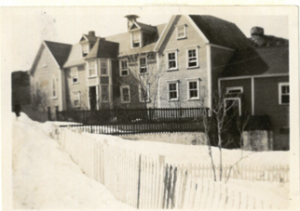
An early photo of St Joseph’s Convent

Sisters of Mercy however, had been ministering in the area around Signal Hill, St. John’s,  as early as 1863, making the daily trek from Mercy Convent on Military Road.

In an address to the people of St. Joseph’s Parish, reported in  the September 10, 1918 issue of The Daily News, Archbishop Roche recalled the long history of the Sisters of Mercy in the area:

The people of St. Joseph’s have obligations of a special nature toward the Sisters of Mercy.  For more than half a century, they have been, practically without interruption, teaching the children of this end of town…    I hope that it may not be too much to expect that in the not- too- distant future the Sisters may have a home in this parish, so as to be near their work and to be able to do for the children what they cannot do under these conditions…

Four years later, the Archbishop’s hopes were realized when St. Joseph’s Convent (known in earlier years as Castle Rennie or Castle Lindberg) was formally blessed and opened.  The Sisters who formed the first community were: Sisters M. Benedicta Fitzgibbons, M. Michael Gillis, M. Ignatius Molloy and a postulant, Margaret Kent.

One hundred years later, six Sisters call St. Joseph’s their home.

Una foto antigua del convento de San José

Sin embargo, las Hermanas de la Misericordia ya ejercían su ministerio en los alrededores de Signal Hill, St. John’s, desde 1863, haciendo el trayecto diario desde el Convento de la Misericordia en Military Road.

En un discurso a los habitantes de la parroquia de St. Joseph, publicado en el número del 10 de septiembre de 1918 de The Daily News, el arzobispo Roche recordó la larga historia de las Hermanas de la Misericordia en la zona:

La gente de St. Joseph tiene obligaciones de naturaleza especial hacia las Hermanas de la Misericordia.  Durante más de medio siglo, han estado, prácticamente sin interrupción, enseñando a los niños de este extremo de la ciudad… Espero que no sea demasiado esperar que en un futuro no muy lejano las Hermanas puedan tener un hogar en esta parroquia, para estar cerca de su trabajo y poder hacer por los niños lo que ellas no pueden hacer en estas condiciones…”.

Cuatro años más tarde, las esperanzas del Arzobispo se hicieron realidad cuando el Convento de San José (conocido en los primeros años como Castillo Rennie o Castillo Lindberg) fue formalmente bendecido e inaugurado.  Las Hermanas que formaron la primera comunidad fueron: Las Hermanas M. Benedicta Fitzgibbons, M. Michael Gillis, M. Ignatius Molloy y una postulante, Margaret Kent.

Cien años más tarde, seis Hermanas llaman a San José su hogar.

Prayer/Reflection for 12 December, Foundation Day

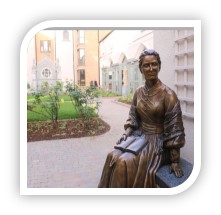
Statue of Catherine McAuley in the grounds of Baggot Street

12 December 1831  marks the date on which Catherine McAuley and her companions, Anna Maria Doyle and Elizabeth Harley, returned to Baggot Street from the Presentation Convent at Georges Hill, having just professed their vows as the first Sisters of Mercy. And so began the story of the Congregation of the Sisters of Mercy,  brought to Newfoundland on 3 June 1842, the first foundation of the Sisters of Mercy in the New World.

Join us in celebrating this special date in the Mercy story using the prayer reflection prepared for the occasion.

El 12 de diciembre de 1831 marca la fecha en que Catalina McAuley y sus compañeras, Anna María Doyle y Elizabeth Harley, regresaron a Baggot Street desde el Convento de la Presentación en Georges Hill, tras haber profesado sus votos como las primeras Hermanas de la Misericordia. Así comenzó la historia de la Congregación de las Hermanas de la Misericordia, llevada a Terranova el 3 de junio de 1842, la primera fundación de las Hermanas de la Misericordia en el Nuevo Mundo.

Acompáñanos en la celebración de esta fecha especial en la historia de la Misericordia utilizando la reflexión de la oración preparada para la ocasión.


St. Clare’s Celebrates 100 Years

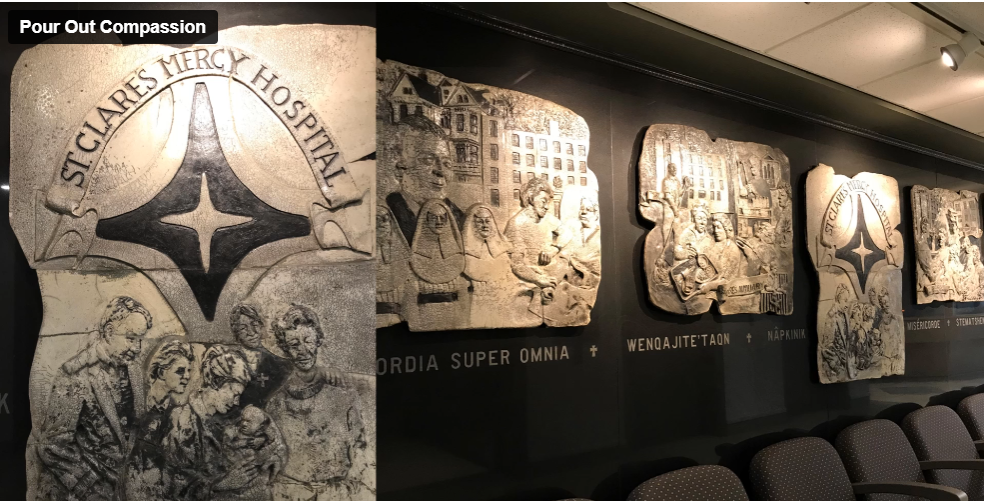
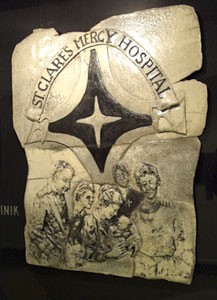
In May of this year St. Clare’s Mercy Hospital celebrated the one hundredth anniversary of its founding.

In this special year of celebration, the Congregational Leadership Team and the members of St. Clare’s Advisory Council made plans to celebrate Mercy Day at the hospital.
On September 27 we met for a special morning prayer in St. Clare’s chapel, along with a number of managers from the hospital. Following the prayer, members of both groups went through every unit and work- place in St. Clare’s, distributing the specially-designed anniversary pins, along with a package of Lindt chocolates for each staff member, a total of nearly 1300.

Managers and staff were most appreciative of the gesture, and were especially delighted to have the opportunity of meeting members of the Advisory Council and seeing the sisters around the units.

Remembering Our Newfoundland Mercy Story 3:

Anniversary of the Founding of Mercy on West Coast of Newfoundland

On July 28, 1893, Sisters M. Antonio Egan, M. Corsini Dempsey, M. Veronica Payne and M. Sylvester Carver, former members of the Sisters of Mercy of Providence, Rhode Island, left Boston, bound for Sandy Point on the west coast of Newfoundland. Mrs. Henrietta Brownell, a friend of Sister M. Antonio and a benefactor of the mission, along with Bishop Michael Howley, Vicar Apostolic of Western Newfoundland, accompanied the band of missionaries to their new home.

Upon arrival at Sandy Point, the sisters received an enthusiastic welcome from the people of Sandy point. The Evening Telegram of August 12, 1893 reported as follows:
As the steamer neared the wharf, a great crowd gathered and salvos
of guns were heard on every side. The line of procession from the wharf to the
Bishop’s house (where the nuns are to be temporarily located) was spanned
by several arches of evergreens … and decorated with wreaths, mottoes and
flags, among which the tri-color of France was particularly conspicuous.

From the Annals of St. Michael’s Convent, St. George’s we learn that once the festivities were over, “the sisters found themselves face to face with the stern difficulties of mission life in a new and poor country.” The annalist went on to say that “the contrast between the school environment of Sandy Point and that of Providence, Rhode Island can be better imagined than described …”

Although plagued with many difficulties and struggles in both community and ministry,the sisters remained steadfast in their dedication to the ideals of the mission they had undertaken so eagerly. In 1899 with the construction of the railway line in St. George’s, the sisters moved from Sandy Point to the new St. Michael’s Convent and school in St. George’s, where they were able to enjoy better accommodations and easier access to resources. The first two boarding students – Sarah Blanchard and Sarah Doyle from Codroy Valley – arrived at St. Michael’s Academy in 1900 to avail of the educational opportunities of the new school. Sarah Doyle entered the Sisters of Mercy in 1906, taking the religious name of Sister Mary Dominic. She was a great-aunt of Sister Sylvia Doyle.

Foundation of Sisters of Mercy, Sandy Point from Diane on Vimeo.

More stories documenting our Newfoundland Mercy Story can be read in “Archival Moments

El 28 de julio de 1893, las Hermanas M. Antonio Egan, M. Corsini Dempsey, M. Veronica Payne y M. Sylvester Carver, antiguas miembros de las Hermanas de la Misericordia de Providence, Rhode Island, salieron de Boston con destino a Sandy Point, en la costa occidental de Terranova. La Sra. Henrietta Brownell, amiga de la Hermana M. Antonio y benefactora de la misión, junto con el Obispo Michael Howley, Vicario Apostólico de Terranova Occidental, acompañaron al grupo de misioneras a su nuevo hogar.

A su llegada a Sandy Point, las hermanas recibieron una entusiasta bienvenida por parte de los habitantes de Sandy Point. El Evening Telegram del 12 de agosto de 1893 informaba de lo siguiente:

Cuando el vapor se acercó al muelle, una gran multitud se reunió y salvas
de armas se oian por todas partes. La linea de la procesion desde el muelle hasta la
de la ciudad, y de la ciudad, y de la ciudad, y de la ciudad, y de la ciudad, y de la ciudad.
y decorada con coronas, lemas y banderas, entre las que destacaba la tricolor.
banderas, entre las que destacaba la tricolor de Francia.

En los Anales del Convento de San Miguel, St. George’s, nos enteramos de que, una vez terminadas las festividades, “las hermanas se encontraron cara a cara con las duras dificultades de la vida de misión en un país nuevo y pobre”. El annalista continuó diciendo que “el contraste entre el ambiente escolar de Sandy Point y el de Providence, Rhode Island puede ser mejor imaginado que descrito…”

Aunque plagadas de muchas dificultades y luchas tanto en la comunidad como en el ministerio,
las hermanas se mantuvieron firmes en su dedicación a los ideales de la misión que habían emprendido con tanto entusiasmo. En 1899, con la construcción de la línea de ferrocarril en St. George’s, las hermanas se trasladaron de Sandy Point al nuevo convento y colegio de St. Michael’s en St. George’s, donde pudieron disfrutar de mejores alojamientos y un acceso más fácil a los recursos. Las dos primeras alumnas internas – Sarah Blanchard y Sarah Doyle de Codroy Valley – llegaron a la Academia de San Miguel en 1900 para aprovechar las oportunidades educativas de la nueva escuela. Sarah Doyle ingresó en las Hermanas de la Misericordia en 1906, tomando el nombre religioso de Hermana Mary Dominic. Era tía abuela de la Hermana Sylvia Doyle.


Remembering Our Newfoundland Mercy Story 2:

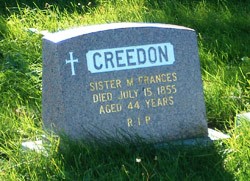
Sr M.Francis Creedon

Today, July 15 is the 167th anniversary of the death of our Newfoundland Mercy founder, Sister M. Francis Creedon.

She died at the age of 44, having been professed as a Sister of Mercy for fourteen years. A woman of great fortitude, zeal for mission and commitment to the ideals of Mercy instilled in her by Catherine McAuley, Francis gave her all to the Newfoundland mission.
She faced many trials and hardships both in community and ministry, but the urgency of the mission and her conviction of the loving Providence of God at work in her life impelled her ever onward. Four young women had joined her since the death of her faithful companion, Sister M. Joseph Nugent in 1847.

The last to enter was Anastasia Tarrahan, the first native Newfoundlander, whom she received into the novitiate on July 2, less than two weeks before her death. Following that ceremony, she responded to a call to visit a dying person in the town and upon her return to Mercy Convent from that visitation she was confined to bed until her death.

The following notice was written in Bishop Mullock’s diary on July 15:

Mrs. Creedon, Superioress of the Convent of Mercy died this morning, a victim of overwork for the poor and the sick.

Hoy, 15 de julio, es el 167 aniversario de la muerte de nuestra fundadora de la Misericordia de Terranova, la Hermana M. Francis Creedon.

Murió a la edad de 44 años, habiendo profesado como Hermana de la Misericordia durante catorce años. Mujer de gran fortaleza, celo por la misión y compromiso con los ideales de la Misericordia que le inculcó Catalina McAuley, Francis lo dio todo por la misión de Terranova.

Se enfrentó a muchas pruebas y dificultades tanto en la comunidad como en el ministerio, pero la urgencia de la misión y su convicción de la amorosa Providencia de Dios actuando en su vida la impulsaron a seguir adelante. Cuatro jóvenes se habían unido a ella desde la muerte de su fiel compañera, la Hermana M. Joseph Nugent en 1847.

La última en ingresar fue Anastasia Tarrahan, la primera nativa de Terranova, a quien recibió en el noviciado el 2 de julio, menos de dos semanas antes de su muerte. Después de esa ceremonia, respondió a una llamada para visitar a un moribundo en la ciudad y a su regreso al Convento de la Misericordia de esa visita fue confinada a la cama hasta su muerte.

La siguiente noticia fue escrita en el diario del obispo Mullock el 15 de julio:

La Sra. Creedon, Superiora del Convento de la Misericordia murió esta mañana, víctima del exceso de trabajo para los pobres y los enfermos.

Remembering Our Newfoundland Mercy Story 1: Burin Peninsula

One hundred fifty-nine years ago this coming week, the Burin Peninsula welcomed the first Sisters of Mercy to its shores.  

Persistent efforts by Burin’s zealous pastor, Father Michael Berney, for whom the education of the children of his parish was of prime importance, finally convinced Mother Xavier Bernard to make a positive response to his entreaties.  St. Anne’s Convent (pictured at right) opened on July 12, 1863. The founding sisters were: Irish-born Sister M. Liguori Carmody; Sister M. Xavier Tarrahan, a Newfoundlander; Sister M. Charles McKenna, also Irish; Mary McAuliffe, a postulant.
The Newfoundlander of July 20, 1863 published a letter describing the arrival of the sisters at the government wharf in Burin on board the steamship Ariel, after a journey of more than twenty-four hours. There, a “tasteful Triumphal Arch” had been erected,  and the long -awaited sisters were greeted with cannon shots and loud cheering from the throngs of people gathered to welcome them. After a visit to the church to receive the bishop’s blessing on the new venture, they were escorted to the priest’s housefor “a collation” by a procession of little girls in white dresses who strewed their path with flowers.

It was an auspicious beginning for St. Anne’s, and the start of a wonderful relationship between the sisters and the people of Burin. The subsequent story of this foundation bears witness to the marvelous ministry of many gifted and dedicated Sisters of Mercy over the years.

Read: Sisters of Mercy presence on the Burin Peninsula

La próxima semana hará ciento cincuenta y nueve años que la península de Burin acogió en sus costas a las primeras Hermanas de la Misericordia.

Los insistentes esfuerzos del celoso párroco de Burin, el padre Michael Berney, para quien la educación de los niños de su parroquia era primordial, convencieron finalmente a la madre Xavier Bernard para que respondiera positivamente a sus súplicas. El convento de Santa Ana (en la foto de la derecha) abrió sus puertas el 12 de julio de 1863. Las hermanas fundadoras fueron: Sor M. Liguori Carmody, de origen irlandés; Sor M. Xavier Tarrahan, de Terranova; Sor M. Charles McKenna, también irlandesa; Mary McAuliffe, postulante.

El Newfoundlander del 20 de julio de 1863 publicó una carta que describía la llegada de las hermanas al muelle gubernamental de Burin a bordo del vapor Ariel, después de un viaje de más de veinticuatro horas. Allí se había erigido un “elegante Arco de Triunfo”, y las tan esperadas hermanas fueron recibidas con cañonazos y fuertes vítores de la multitud de gente reunida para darles la bienvenida. Después de una visita a la iglesia para recibir la bendición del obispo, fueron escoltadas a la casa del sacerdote para “una colación” por una procesión de niñas vestidas de blanco que llenaron su camino de flores.

Fue un comienzo auspicioso para Santa Ana, y el inicio de una maravillosa relación entre las hermanas y el pueblo de Burin. La historia posterior de esta fundación es testimonio del maravilloso ministerio de muchas Hermanas de la Misericordia dotadas y entregadas a lo largo de los años.

Remembering Catherine McAuley 2019

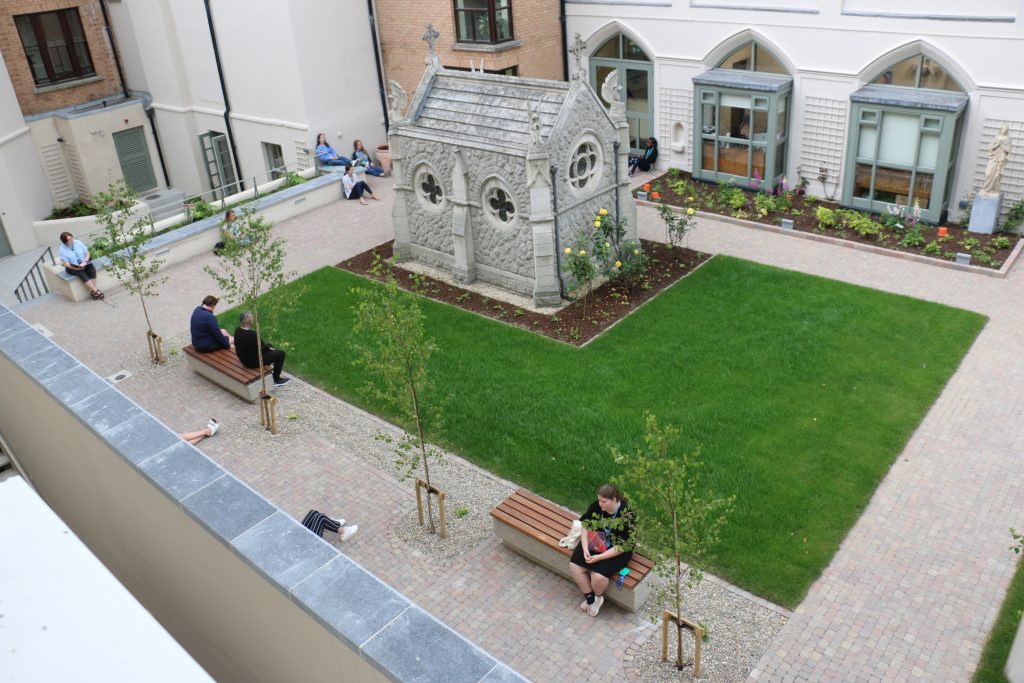
Sacred Garden at Baggot Street – Holder of Holiness
11 November 2019

This September we joined with many Sisters of Mercy, Associates and others around the world to celebrate the 25th Anniversary of Mercy International. The renovation of our founding house at 64A Baggot Street and its establishment as a Mercy Centre for pilgrimage, heritage, hospitality and spirituality has proven to be a blessing for Sisters of Mercy around the world, for our colleagues and for many of us personally. This year we celebrate twenty-five years! We are definitely an international group connected by our common history, heritage and spirituality!

So now in September 2019, the 192th anniversary of the opening of the House of Mercy, the sacred garden at Baggot Street has been renewed and re-dedicated with blessing and celebration. The presence of so many Sisters of Mercy, Associates and colleagues (in person and via modern technology) was definitely an unprecedented international celebration throughout the Mercy world! We are delighted that Patricia, Monica and Elizabeth had prominent roles in these celebrations!

In 1841 shortly after her death, Catherine McAuley was buried in the convent garden at Baggot Street thus making it sacred and holy ground. The next Sister of Mercy to be buried there, one month after Catherine, was Anne Fleming (Sr. Mary Justina), niece of Bishop Fleming. Anne was in the novitiate at Baggot Street and professed on the same date, August 19, 1841, as Marianne Creedon (Sr. M. Francis), Foundress of the Mercy community in Newfoundland. We know that Francis was present with Catherine in her dying and would have been part of the prayer and burial in that garden as well as the burial of her novitiate companion, Justina Fleming, soon after. Bishop Fleming was in Dublin in November 1841 and we might surmise that he was present at Catherine’s funeral and burial and perhaps, the burial of his niece! Thus the garden at Baggot Street takes on additional meaning and significance to us here in Newfoundland.

We have been offered a virtual visit to the garden:Remembering in the Sacred Garden, Baggot Street in this video:

Let us take a few moments to go to the garden at Baggot Street in Dublin, to think about Catherine McAuley, Justina Fleming and the other sisters buried there. Let us think about the hundreds of Sisters of Mercy buried in sacred grounds around the world. Let us remember them with gratitude and love. Let us remember Associates and colleagues who have died.

Also, on this November 11 we are called to remember men and women who died in the two World Wars! We remember them!
Photos: Anne Walsh

Remembering Catherine McAuley 11 November

Catherine McAuley’s Death  

In the evening of Thursday, November 11, 1841, Catherine McAuley, the founder of the Sisters of Mercy, died of tuberculosis at the Convent of Mercy on Baggot Street, Dublin—the first of twelve convents she had established in the preceding decade. She was surrounded by members of the Baggot Street (editor: including sister Mary Francis Creedon), Booterstown, and Limerick communities, some of whom have left written eye-witness reports.  Mary Elizabeth Moore (1806-1868), superior of the convent in Limerick, wrote ten days after Catherine McAuley’s death to the superior of the Mercy convent in Tullamore (founded in 1836):

She died the Death of the Just. Cautious as she was from       bringing herself into notice unnecessarily in health she was still more so in sickness, waiting on herself even in her last agony, preserving to the last moment the same peace and serenity of mind which so eminently distinguished her through Life . . . . her first and last injunction to all was to preserve union and peace amongst each other . . . .

. . . . About five in the evening she asked for the candle to be placed in her hand.

We commenced the last prayers . . . .

When we thought the senses must be going and that it might be well to rouse attention by praying a little louder, she said: No occasion, my darling, to speak so loud, I hear distinctly. In this way she continued till 10 minutes before 8 when she calmly breathed her last sigh.

I did not think it possible for Human Nature to have such self-possession at the awful moment of Death but she had an extraordinary mind in Life and Death. (Letter to Mary Ann Doyle, 21 November 1841)


A Place of Pilgrimage: The Grave of Catherine McAuley

The earth grave in which the coffined body of Catherine McAuley was buried on November 15, 1841, is now sheltered by the small stone oratory built over the site in 1910     (Neumann, ed., Letters, 47). Of all the venues of pilgrimage at Mercy International Centre,

Catherine’s grave is the most frequented and the most profoundly reverenced. Here people stand, alone or in groups, in the early morning, during the day, or at twilight. Here they sense the presence of the God in whose providence Catherine McAuley had such great confidence. Here they sing hymns or pray silently or aloud in her spirit, sometimes using the words of her own “Suscipe”:

My God, I am Thine for all eternity; teach me to cast my whole self into the arms of Thy Providence with the most lively unlimited confidence in Thy compassionate tender pity.

Grant, O most Merciful Redeemer, that whatever Thou dost ordain or permit may always be acceptable to me; take from my heart all painful anxiety; suffer nothing to afflict me, but sin; nothing to delight me, but the hope of coming to the possession of Thee, my God, in Thy own everlasting Kingdom. Amen. (Limerick Manuscript)

In this spirit pilgrims to Catherine McAuley’s grave privately ask her to intercede for them and then confidently abandon their needs to God. Sometimes they leave flowers, candles, or handwritten notes; sometimes they take photographs. Always they depart with peace and gratitude for this experience.

Mary Sullivan rsm


Celebrating Fifty Years- St. Clare’s Auxiliary

On 23 October 2017 more than one hundred guests gathered at Government House in St. John’s, NL to mark the 50th Anniversary of the founding of the St. Clare’s Mercy Hospital Auxiliary.

Their Honours Mr. Frank and Patricia Fagan were hosts in the beautiful and historic residence of the Lieutenant Governor of Newfoundland and Labrador.  Former Presidents of the Auxiliary, past and currents members as well as a number of Sisters of Mercy and other friends were in attendance.  Refreshments were graciously served by Government House staff.   Guests and Governor Fagan and his wife mingled about the grand reception rooms.

The Governor spoke for a few minutes to commend the group on reaching this milestone and to thank them for the wonderful work that the Auxiliary  members have done and continue to do on behalf of those who seek health and healing at St. Clare’s.  With grace and hospitality he welcomed everyone to Government House and invited them to explore the rooms and enjoy the beauty and history of the building.

Sister Elizabeth Davis, Leader of the Sisters of Mercy, spoke a few words of greeting to the auxiliary and thanked them for their dedicated and generous service to St. Clare’s and to the patients and families who come there.

Then an address was given by Mrs. Joan Parker Crosbie,  the first President of the Auxiliary:

Your Honours, Mr. and Mrs. Fagan, Sisters of St. Clare’s, President of the St. Clare’s Auxiliary, Auxiliary Past Presidents of the Auxiliary and friends:

It is hard to believe that it was fifty years since the beginning of the auxiliary.  It was a very humble beginning but the enthusiasm of all the members was great.  I would be amiss if I didn’t mention all the encouragement we received from Sister Mary Aidan, Sister Fabian and all the Sisters. The auxiliary reminds me of the proud oak tree that grows from a tiny acorn.

We had a great time starting the auxiliary and many new friendships were formed.  We had a shower and members brought things to sell in the gift shop.  We had a Ball at the Old Colony Club and an auction during the Ball.  I only remember one item (to be auctioned) and that was Ray Guy’s salt and pepper cap.  The paper from inside the rim was missing as he got short-taken out in the woods.  Then there was the Sale of Work.  We took our knitting needles, sewing machine and all Sisters joined in.  They also made the wonderful fudge, which was the first thing to sell out.

I am now at an age that memories are important.  I must say that my memories of St. Clare’s Auxiliary are very happy and proud ones.  I never could imagine that it would grow to the size that it is today.

Congratulations to all the members over the 50 years that have made the auxiliary what it is today.

Appreciation to Governor Fagan was expressed by Leslie Darraugh, current President of the Auxiliary.  Some photos were taken of many of the previous presidents who were in attendance.  It was the end of a lovely and memorable event.

Mrs. Joan Parker Crosbie
Lt. Governor Frank and Mrs. Patricia Fagan
Auxiliary Presidents
Beautiful Decor of Government House

Celebration of 100 Years: Presence of Sisters of Mercy on Bell Island

On Monday evening we attended a most impressive celebration on Bell Island at the invitation of St. Michael’s Parish.  Exactly one hundred years ago, on 19 September 1917, four Sisters (Sisters Mary Consilio, Mary Cecily O’Reilly, Alphonsus McNamara and Mary Aloysius Rawlins) crossed the Tickle and founded our community at the Front.

The people of St. Michael’s Parish invited any Sisters who could attend to join them for Mass, dinner and music. Twenty-one of us joined them for the special evening.

(Going around the table beginning on left)  Srs. Charlotte Fitzpatrick, Maureen Lawlor, Eileen Penney, Barbara Kenny, Rosaline Hynes, Ruth Beresford, Marcella Grant, Sheila Grant, Theresa Boland, Rosemary Ryan- 10 of the 21 Sisters who attended.

The crossing on the new ferry, the Legionnaire, was beautiful – calm and sunny.  The Archbishop and eight priests joined us for the trip.  We were met at the ferry by several Knights of Columbus who offered us drives if needed.  We went directly to Church and joined the parishioners and many others who had come back home for the occasion.

The bell, used at the original St. Michael’s Church and preserved by St. Michael’s High School, was relocated to the grounds of the modern St. Michael’s Parish Church (build on the site of the Immaculate Conception Church after it had burned to the ground).  Archbishop Currie blessed the bell, rang it and then invited a small choir from St. Michael’s School to lead us in O Canada and the Ode to Newfoundland. The bell has so much significance in joyfully in linking our built heritage with the geography of this Island.

We then went into the Church for Mass at which the Archbishop presided.  The sanctuary was lovely, adorned by a single vase of red roses and new white altar cloths with gold embroidery.  The School choir joined the adult choir to lead us in song.  Members of the parish led the Liturgy of the Word.  The Archbishop, in his homily, recalled some of our history on Bell Island right up to the present day with a special mention of Sister Phyllis’ pastoral presence.  He reminded us that the Ode to Newfoundland was sung for the very first time at the opening of the first Catholic school on the Island in 1901!

Parish hall beautifully prepared for the celebration
Display: Timeline showing some of the events
of the past 100 years


Read more about the wonderful celebrations on Bell Island. Download the report here