This video introduction to Pope Leo’s Encyclical commences with these words: “An encyclical dedicated to you. Dedicated to your magnificent humanity. This humanity that is created by God. A humanity that we must care for and protect.”
Watch it here (3:51)
Este vídeo de presentación de la encíclica del papa León comienza con estas palabras: «Una encíclica dedicada a vosotros. Dedicada a vuestra magnífica humanidad. Esa humanidad creada por Dios. Una humanidad que debemos cuidar y proteger».
Marking the 135th anniversary of Rerum novarum, Pope Leo XIV releases his first encyclical, entitled ‘Magnifica humanitas: On Safeguarding the Human Person in the Time of Artificial Intelligence.’ He appeals for the safeguarding of humanity, promotion of truth, dignity of work, social justice, and peace.
By Isabella Piro
“Humanity, created by God in all its grandeur, is today facing a pivotal choice: either to construct a new Tower of Babel or to build the city in which God and humanity dwell together.”
Published on Monday, May 25, the Pope signed the encyclical on May 15, the 135th anniversary of the promulgation of Pope Leo XIII’s Rerum novarum.
Watch Pope Leo’s presentation (10:30):
Pope Leo XIV has taken up the legacy of his predecessor, writing a social encyclical which addresses one of the principal challenges of the contemporary age: artificial intelligence.
Divided into five chapters, Magnifica humanitas has an underlying premise: technology is not “a force antagonistic to humanity” (4), nor is it “inherently evil” (9). However, “technology is never neutral, because it takes on the characteristics of those who devise, finance, regulate, and use it.
Therefore, Pope Leo XIV appeals for people to build “for the common good” and to “remain human,” following a courageous mentality of shared responsibility and communion, so that the world “will come to recognize the human heart as the place where God desires to dwell” (16).
The Dicastery for Poromoting Integral Human Developmenthas made available a pastoral proposal with resources aimed at facilitating the understanding and in-depth analysis of the Encyclical.
Con motivo del 135.º aniversario de *Rerum novarum*, el papa León XIV publica su primera encíclica, titulada «*Magnifica humanitas: Sobre la protección de la persona humana en la era de la inteligencia artificial*». En ella, hace un llamamiento a la protección de la humanidad, la promoción de la verdad, la dignidad del trabajo, la justicia social y la paz.
Por Isabella Piro
«La humanidad, creada por Dios en toda su grandeza, se enfrenta hoy a una elección crucial: o bien construir una nueva Torre de Babel, o bien edificar la ciudad en la que Dios y la humanidad convivan juntos».
Las palabras iniciales de la primera encíclica del papa León XIV, Magnifica humanitas: Sobre la salvaguardia de la persona humana en la era de la inteligencia artificial, resumen sus razones y su propósito fundamentales.
Publicada el lunes 25 de mayo, el Papa firmó la encíclica el 15 de mayo, en el 135.º aniversario de la promulgación de la Rerum novarum del papa León XIII.
El papa León XIV ha recogido el legado de su predecesor al redactar una encíclica social que aborda uno de los principales retos de la era contemporánea: la inteligencia artificial.
Dividida en cinco capítulos, *Magnifica humanitas* parte de una premisa fundamental: la tecnología no es «una fuerza antagónica a la humanidad» (4), ni es «intrínsecamente mala» (9). Sin embargo, «la tecnología nunca es neutral, porque adquiere las características de quienes la conciben, la financian, la regulan y la utilizan».
Por lo tanto, el papa León XIV hace un llamamiento a que las personas construyan «por el bien común» y «sigan siendo humanas», siguiendo una mentalidad valiente de responsabilidad compartida y comunión, para que el mundo «llegue a reconocer el corazón humano como el lugar donde Dios desea morar» (16).
Lee aquí un resumen de cada uno de los 5 capítulos
To mark the first anniversary of Pope Francis’ death, Vatican News have released a 27-minute documentary—subtitled in Italian, English, and Spanish—which, through archival footage and symbolic sequences, recounts the pontificate of ‘the Pope of mercy’ and ‘the Pope of the peripheries,’ highlighting his most emblematic expressions and gestures.
Watch the video which traces the story of Pope Francis’ pontificate from his election (March 13, 2013) to his death (April 21, 2025).
Con motivo del primer aniversario de la muerte del papa Francisco, Vatican News ha publicado un documental de 27 minutos —subtitulado en italiano, inglés y español— que, a través de imágenes de archivo y secuencias simbólicas, repasa el pontificado del «papa de la misericordia» y del «papa de las periferias», destacando sus expresiones y gestos más emblemáticos.
Ve el vídeo que recorre la historia del pontificado del papa Francisco desde su elección (13 de marzo de 2013) hasta su fallecimiento (21 de abril de 2025).
On Tuesday, April 21, the first anniversary of the death of Pope Francis, Vatican News will broadcast a live Rosary and Mass at the Basilica of St. Mary Major and release a documentary to recall the late Argentine Pope.
Vatican News
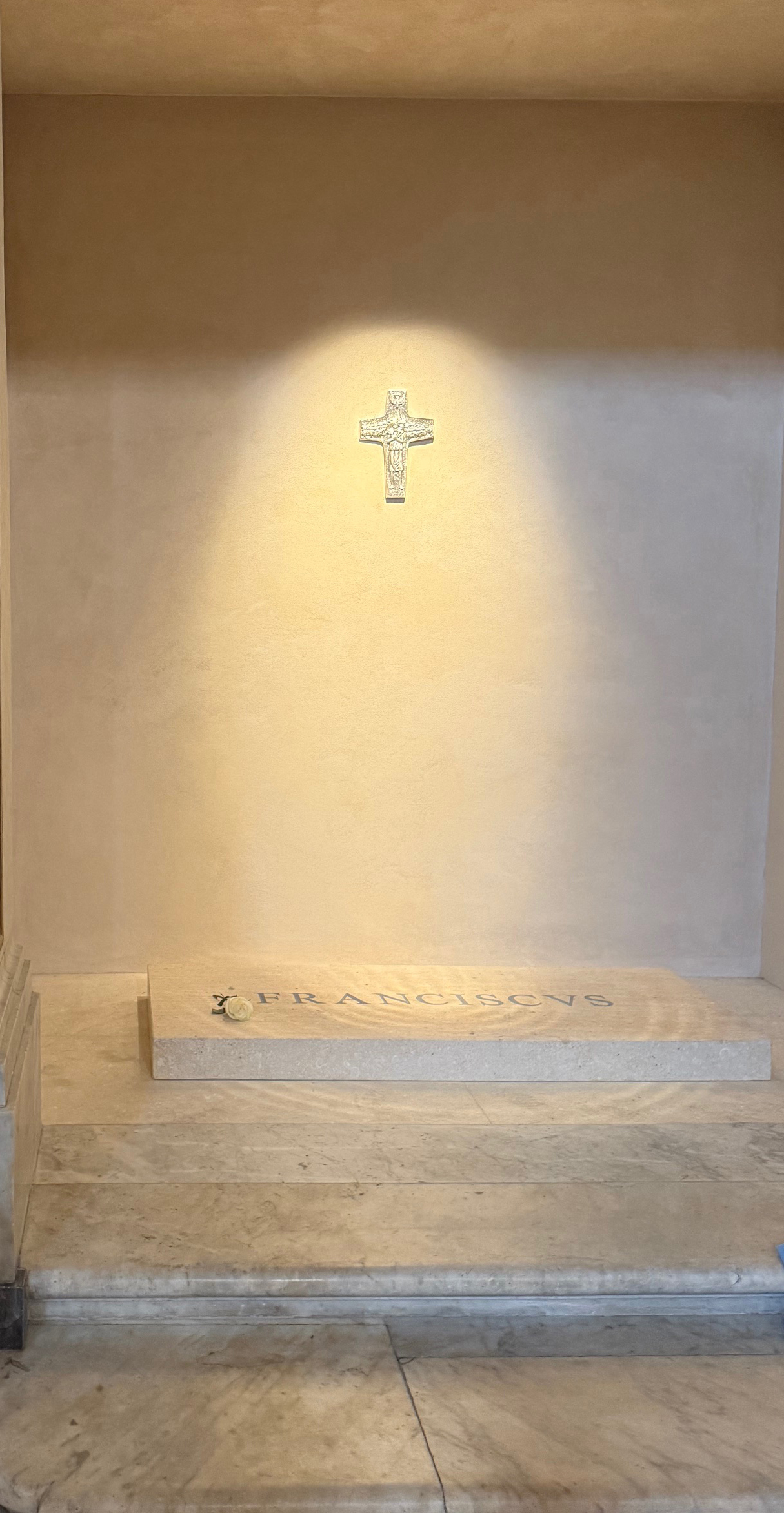
Grave of Pope Francis AW/AWC
It has been a year since the death of Pope Francis, which occurred at Casa Santa Marta at 7:35 a.m. on April 21, 2025.
Five days later, his funeral took place, and his mortal remains, according to his wishes, have since rested in the Marian Basilica of St. Mary Major, which is preparing to solemnly mark the anniversary.
The Program
The Basilica announced that the tribute will begin with a recitation of the rosary at 12:30 p.m. Newfoundland time in the Pauline Chapel, where Pope Francis visited dozens of times.
Afterwards, on the right side of the Chapel, a commemorative plaque will be unveiled to honor the special bond between Pope Francis and the icon of Mary Salus Populi Romani.
The bronze plaque bears a Latin inscription of 160 characters in two different sizes, which reads: “Francis Supreme Pontiff, who paused 126 times in devout prayer at the feet of the Salus Populi Romani; according to his will, rests in this Papal Basilica.”
Link to Follow the Event via Live Streaming
After the Rosary, at 1:30 p.m. Newfoundland time, the Mass will be celebrated, during which a message from Pope Leo XIV, currently on his Apostolic Journey in Africa, will be read.
During Pope Leo XIV’s Prayer Vigil for Peace in the world [April 11], the Pope appealed to leaders of nations to stop and sit at the table of dialogue and mediation, “not at the table where rearmament is planned and deadly actions are decided!” He also insisted that the Church will always advance in calling for peace “even when rejecting the logic of war may lead to misunderstanding and scorn,” and will always instil “obedience to God rather than any human authority.”…
The Pope thanked all those present and all those praying from afar for praying for peace, noting that their prayer is an expression of that faith which, as Jesus reminded, moves mountains. He began by recalling that: “War divides; hope unites. Arrogance tramples upon others; love lifts up. Idolatry blinds us; the living God enlightens.”
Yet, he reassured, “all it takes is a little faith, a mere ‘crumb’ of faith, in order to face this dramatic hour in history together — as humanity and alongside humanity.” He emphasized that prayer is not “a refuge in which to hide from our responsibilities, nor an anesthetic to numb the pain provoked by so much injustice,” but rather is “the most selfless, universal and transformative response to death.”
Nothing can confine us to a predetermined fate
In this context, he argued, “Nothing can confine us to a predetermined fate, not even in this world where there never seem to be enough graves, for people continue to crucify one another and eliminate life, with no regard to justice and mercy.”…
Durante la Vigilia de Oración por la Paz en el mundo celebrada por el papa León XIV [el 11 de abril], el Papa hizo un llamamiento a los líderes de las naciones para que se detuvieran y se sentaran a la mesa del diálogo y la mediación, «¡no a la mesa donde se planea el rearme y se deciden acciones mortíferas!». También insistió en que la Iglesia siempre seguirá adelante con su llamamiento a la paz «incluso cuando rechazar la lógica de la guerra pueda dar lugar a malentendidos y desprecio», y siempre inculcará «la obediencia a Dios antes que a cualquier autoridad humana»…
El Papa agradeció a todos los presentes y a todos aquellos que rezaban desde lejos por la paz, señalando que su oración es una expresión de esa fe que, como recordó Jesús, mueve montañas. Comenzó recordando que: «La guerra divide; la esperanza une. La arrogancia pisotea a los demás; el amor eleva. La idolatría nos ciega; el Dios vivo nos ilumina».
Sin embargo, aseguró: «Basta un poco de fe, una mera “miga” de fe, para afrontar juntos —como humanidad y junto a la humanidad— este momento dramático de la historia». Subrayó que la oración no es «un refugio en el que escondernos de nuestras responsabilidades, ni un anestésico para adormecer el dolor provocado por tanta injusticia», sino más bien «la respuesta más desinteresada, universal y transformadora a la muerte».
Nada puede confinarnos a un destino predeterminado
En este contexto, argumentó: «Nada puede confinarnos a un destino predeterminado, ni siquiera en este mundo en el que nunca parecen haber suficientes tumbas, pues las personas siguen crucificándose unas a otras y eliminando la vida, sin tener en cuenta la justicia y la misericordia»…
Pope Leo has welcomed the news of a ceasefire in the Middle East and asks that all parties engage in prolonged dialogue to reach an end to the conflict. He also invites men and women of goodwill across the world to join him in prayer for peace on Saturday 11 April.
At the conclusion of his General Audience on Wednesday, 8 April, Pope Leo turned his thoughts to the weeks of tension that have been escalating in the Middle East. In light of the announcement of a two-week ceasefire on the evening of 7 April, the Pope said he welcomed the news “with satisfaction and as a sign of deep hope”.
Addressing the faithful gathered in St Peter’s Square, the Pope emphasised that “only through a return to the negotiating table can we bring the war to an end”. He went on to urge those gathered to accompany this time of delicate diplomatic work with prayer, “in the hope that a willingness to engage in dialogue may become the means to resolve other situations of conflict throughout the world”.
Finally, the Pope reminded the faithful that on Saturday, 11 April, a Prayer Vigil for Peace will be celebrated in St Peter’s Basilica, and that everyone, both in person or following from home, is invited to join. The Vigil will take place at 1:30 pm Newfoundland time and will be presided over by the Holy Father. No tickets are required for those attending in person.
El papa León ha acogido con satisfacción la noticia de hoy sobre el alto el fuego en Oriente Medio y pide a todas las partes que entablen un diálogo prolongado para poner fin al conflicto. Asimismo, invita a los hombres y mujeres de buena voluntad de todo el mundo a unirse a él en oración por la paz el sábado 11 de abril.
Al término de su audiencia general del miércoles 8 de abril, el papa León se refirió a las semanas de tensión que se han ido intensificando en Oriente Medio. A la luz del anuncio de un alto el fuego de dos semanas realizado en la tarde del 7 de abril, el Papa ha dicho que acogía la noticia «con satisfacción y como un signo de profunda esperanza».
Dirigiéndose a los fieles reunidos en la Plaza de San Pedro, el Papa ha subrayado que «solo volviendo a la mesa de negociaciones podremos poner fin a la guerra». A continuación, instó a los allí reunidos a acompañar este delicado momento de trabajo diplomático con la oración, «con la esperanza de que la voluntad de entablar el diálogo se convierta en el medio para resolver otras situaciones de conflicto en todo el mundo».
Por último, el Papa recordó a los fieles que el sábado 11 de abril se celebrará una Vigilia de Oración por la Paz en la Basílica de San Pedro, y que todos, tanto en persona como desde casa, están invitados a participar. La vigilia tendrá lugar a las 13:30 h, hora de Terranova, y estará presidida por el Santo Padre. No se requieren entradas para quienes asistan en persona.
En una declaración desde Castel Gandolfo, León XIV hace un llamamiento a la paz e invita a ponerse en contacto con los miembros del Congreso para pedir el fin de la guerra, pensando en las numerosas víctimas inocentes.
Vatican News
“Hoy, como todos sabemos, se ha producido también esta amenaza contra todo el pueblo de Irán, y esto es realmente inaceptable”, claras y directas fueron las palabras del Papa León XIV a las puertas de su residencia en Castel Gandolfo. En una breve declaración a los periodistas, primero en italiano y luego en inglés, esta noche del 7 de abril, reitera la urgencia de la paz, pensando en la grave situación que se está viviendo, ante el ultimátum lanzado por el presidente estadounidense Donald Trump a Irán con la amenaza de destruirlo todo en una noche si no se aceptan las condiciones impuestas previamente y rechazadas por Teherán en relación con el estrecho de Ormuz.
El Papa recuerda las palabras sobre la paz pronunciadas el Domingo de Pascua en el Urbi et Orbi, cuando hizo un llamamiento a deponer las armas a «quienes tienen el poder de desencadenar guerras», eligiendo el camino del diálogo y no el de la fuerza. Subraya que están en juego «cuestiones de derecho internacional», pero que, sobre todo, hay «una cuestión moral» en la que hay que tener presente el bien del pueblo. El pensamiento se dirige sobre todo a los más vulnerables, víctimas de una escalada.
Given the right kind of conditions, it is possible to enter Holy Week from the inside rather than the outside – not as a series of commemorative events surrounding the final days of Jesus’ earthly life, but as a way of actually accompanying Jesus on His timeless passage through death to the very source of life and back into this world, with the unshakable certainty that “nothing can separate us from the love of God.”
It is a passage, as Christian mystics from time immemorial have proclaimed, that changed the very foundations of this world. And it is a passage that we ourselves will personally make, carriedon the wings of this one Great Passage, when our own human lives have reached their fullness of time.
-Cynthia Bourgeault
Si se dan las condiciones adecuadas, es posible entrar en la Semana Santa desde dentro y no desde fuera: no como una serie de actos conmemorativos en torno a los últimos días de la vida terrena de Jesús, sino como una forma de acompañar realmente a Jesús en su paso intemporal a través de la muerte hasta la fuente misma de la vida y de vuelta a este mundo, con la certeza inquebrantable de que “nada puede separarnos del amor de Dios”.
Es un paso, como han proclamado los místicos cristianos desde tiempos inmemoriales, que cambió los cimientos mismos de este mundo. Y es un paso que nosotros mismos daremos personalmente, llevados por las alas de este Gran Paso, cuando nuestras propias vidas humanas hayan llegado a su plenitud.
Ahead of the start of Lent (February 18 – April 2), Pope Leo XIV invites Catholics to open ourselves to listening, fasting, and community, urging us to abstain from words of hatred in order to make space for words of hope and peace.
“I would like to invite you to a very practical and frequently unappreciated form of abstinence: that of refraining from words that offend and hurt our neighbor.”
Pope Leo XIV made that invitation at the heart of his message for Lent 2026, which was released on Friday, February 13.
As Lent begins on Ash Wednesday, February 18, the Pope said this liturgical season offers Christians an opportunity to place the mystery of God back at the center of our lives.
Every journey of conversion, he said, begins by letting God’s word touch our hearts, so that we may renew our commitment to follow Christ in the mystery of His saving passion, death, and resurrection…”
Antes del inicio de la Cuaresma (del 18 de febrero al 2 de abril), el papa León XIV invita a los católicos a abrirnos a la escucha, al ayuno y a la comunidad, instándonos a abstenernos de palabras de odio para dar espacio a palabras de esperanza y paz.
«Me gustaría invitarles a una forma de abstinencia muy práctica y a menudo poco apreciada: la de abstenerse de palabras que ofenden y hieren a nuestro prójimo».
El papa León XIV hizo esta invitación en el centro de su mensaje para la Cuaresma de 2026, publicado el viernes 13 de febrero.
Al comenzar la Cuaresma el Miércoles de Ceniza, 18 de febrero, el Papa dijo que este tiempo litúrgico ofrece a los cristianos la oportunidad de volver a situar el misterio de Dios en el centro de nuestras vidas.
Todo camino de conversión, dijo, comienza dejando que la palabra de Dios toque nuestros corazones, para que podamos renovar nuestro compromiso de seguir a Cristo en el misterio de su pasión salvadora, muerte y resurrección…».
Brigid of Kildare is the patron saint of healers, poets, artists, dairy workers and midwives. One of the three great patronal saints of Ireland, she is also known as a model of equality, an environmentalist and an icon of Christian womanhood.
Interest in Brigid rekindled in the 1990s, and in 2023 the Irish government proclaimed her feast day, February 1st as a national holiday.
Learn more about Brigid in this newly released video (21:28)
Brigid de Kildare es la santa patrona de los curanderos, poetas, artistas, trabajadores lácteos y comadronas. Es una de las tres grandes santas patronas de Irlanda y también es conocida como modelo de igualdad, ecologista e icono de la feminidad cristiana.
El interés por Brigid se reavivó en la década de 1990 y, en 2023, el Gobierno irlandés proclamó su festividad, el 1 de febrero, como fiesta nacional.



 “I would like to invite you to a very practical and frequently unappreciated form of abstinence: that of refraining from words that offend and hurt our neighbor.”