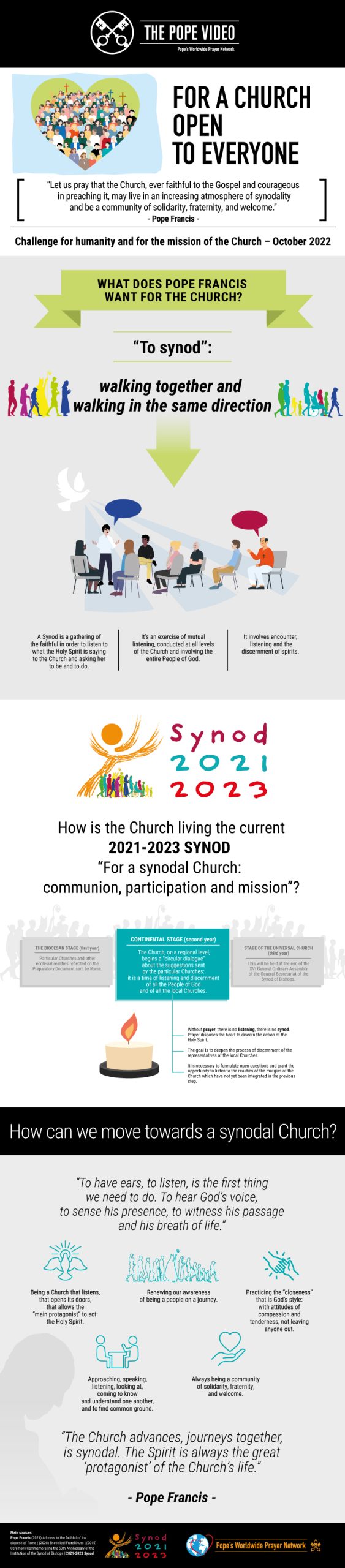
In his prayer intention for October, Pope Francis invites the members of the Church to listen to each other in their diversity and to open the doors to those who are outside.
We pray for the Church; ever faithful to, and courageous in preaching the Gospel, may the Church be a community of solidarity, fraternity and welcome, always living in an atmosphere of synodality.
The overall objective of this day is to raise awareness of mental health issues around the world and to mobilize efforts in support of mental health.
The Covid-19 pandemic has created a global crisis for mental health. In addition to the isolation and anxiety which undermined the mental health of millions, there was a severe disruption of mental health services and a widening of the treatment gap for mental health conditions.
Furthermore, huge social and economic inequalities, the escalation of wars and other forms of violence, public health emergencies, natural disasters, the uprooting and migration of peoples at unprecedented levels all affect the mental health of individuals and communities, locally and globally.
This year the World Health Organization is partnering with other organizations to launch a campaign around the theme: Making Mental Health and Well-Being for all a Global Reality. This initiative aims to bring together people with mental health conditions, advocates, governments, employers and other stakeholders to increase awareness about which preventive mental health interventions work and what needs to be done to ensure that everyone has equal access to the mental health care they need.
El objetivo general de este día es concienciar sobre los problemas de salud mental en todo el mundo y movilizar esfuerzos en apoyo de la salud mental.
La pandemia de Covid-19 ha creado una crisis mundial para la salud mental. Además del aislamiento y la ansiedad que minaron la salud mental de millones de personas, se produjo una grave alteración de los servicios de salud mental y un aumento de las diferencias en el tratamiento de las afecciones mentales.
Por otra parte, las enormes desigualdades sociales y económicas, la escalada de guerras y otras formas de violencia, las emergencias de salud pública, las catástrofes naturales, el desarraigo y la migración de los pueblos a niveles sin precedentes afectan a la salud mental de las personas y las comunidades, a escala local y mundial.
Este año, la Organización Mundial de la Salud se asocia con otras organizaciones para lanzar una campaña en torno al tema: Hacer de la salud mental y el bienestar para todos una realidad mundial. Esta iniciativa pretende reunir a personas con problemas de salud mental, defensores, gobiernos, empleadores y otras partes interesadas para aumentar la concienciación sobre qué intervenciones preventivas de salud mental funcionan y qué hay que hacer para garantizar que todo el mundo tenga igual acceso a la atención de salud mental que necesita.
On Sunday, September 18th, the people of Conception Harbour organized a sent-forth appreciation gathering for Sisters Geraldine Mason and Ellen Sullivan.
This day was an opportunity for the people to officially say ‘Thank you’ to these sisters who have impacted so much the life of the people.
The celebrations began with Mass at 10:30am after which those present moved to the Marion Hall for the appreciation gathering.
Enjoy watching the celebration video.
El domingo 18 de septiembre, el pueblo de Conception Harbour organizó una reunión de agradecimiento a las hermanas Geraldine Mason y Ellen Sullivan.
Este día fue una oportunidad para que el pueblo dijera oficialmente “Gracias” a estas hermanas que tanto han impactado la vida del pueblo.
Las celebraciones comenzaron con la Misa a las 10:30am después de la cual los presentes se trasladaron al Marion Hall para la reunión de agradecimiento.
In 2015, Pope Francis wrote Laudato Si’, his encyclical letter about the environmental crisis to every single person in the world.
Now, four voices from Senegal, the Amazon, India, and Hawai’i, bring perspective and solutions from the poor, the indigenous, the youth, and wildlife into a conversation with Pope Francis himself.
This 80 minute documentary follows their journey to Rome and the extraordinary experiences that took place there, and is packed with powerfully moving personal stories alongside the latest information about the planetary crisis and the toll it’s taking on nature and people.
Watch it here.
En 2015, el Papa Francisco escribió Laudato Si’ , su carta encíclica sobre la crisis medioambiental dirigida a todas las personas del mundo.
Ahora, cuatro voces de Senegal, el Amazonas, la India y Hawái aportan la perspectiva y las soluciones de los pobres, los indígenas, los jóvenes y la vida silvestre en una conversación con el propio Papa Francisco.
Este documental de 80 minutos sigue su viaje a Roma y las extraordinarias experiencias que allí tuvieron lugar, y está repleto de historias personales poderosamente conmovedoras junto con la información más reciente sobre la crisis planetaria y los estragos que está causando en la naturaleza y las personas.
La película se presentó el 4 de octubre, fiesta de San Francisco, fecha que cierra el Tiempo de la Creación y
el mismo día de la entrada oficial de la Santa Sede en el histórico acuerdo de París sobre el cambio climático.
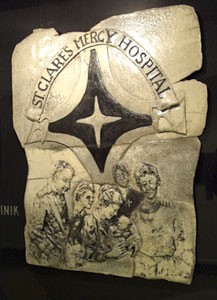
In May of this year St. Clare’s Mercy Hospital celebrated the one hundredth anniversary of its founding.
In this special year of celebration, the Congregational Leadership Team and the members of St. Clare’s Advisory Council made plans to celebrate Mercy Day at the hospital.
On September 27 we met for a special morning prayer in St. Clare’s chapel, along with a number of managers from the hospital. Following the prayer, members of both groups went through every unit and work- place in St. Clare’s, distributing the specially-designed anniversary pins, along with a package of Lindt chocolates for each staff member, a total of nearly 1300.
Managers and staff were most appreciative of the gesture, and were especially delighted to have the opportunity of meeting members of the Advisory Council and seeing the sisters around the units.
The National Day of Truth and Reconciliation has been set aside to provide the people of Canada an opportunity to recognize and commemorate the intergenerational harm that residential schools have caused to Indigenous families and communities and to honor those who have been affected by these injustices. The annual observance of this day was one of the Calls to Action from the Truth and Reconciliation Commission of Canada.
In a news release from the Government of Newfoundland and Labrador on September 14, 2022, the Honorable Lisa Dempster, Minister Responsible for Indigenous Affairs and Reconciliation, wrote as follows:
We share a collective responsibility to learn and understa how residential schooling in Canada had a traumatic and profound effect on survivors, families and communities … More than just reflecting and remembering, we must commit and strive to do better.
The great feast that unites the Mercy world is Mercy Day, 24 September.La gran fiesta que une al mundo de la Misericordia es el Día de la Misericordia, el 24 de septiembre.
Catherine McAuley, Foundress
Many blessings as we remember and celebrate Mercy Day! ¡Muchas bendiciones al recordar y celebrar el Día de la Misericordia!
A Reflection has been prepared for this day which you may wish to use to celebrate with us. Se ha preparado una Reflexión para este día que puede utilizar para celebrar con nosotros.
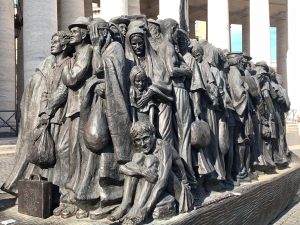
The Church has been celebrating the World Day of Migrants and Refugees (WDMR) since 1914
“Angels Unawares” sculpture by Timothy Schmalz
September 25 is a day set aside by the Church to reflect on the plight of migrants and refugees. The theme for this year is Building the Future with Migrants and Refugees, a theme which takes on particular meaning in today’s world. Pope Francis’ message for this occasion can be found here
This year’s theme also has particular relevance in the current Canadian context. More than 500,00 people are living and working in Canada without status or in precarious situations.
The Canadian government is looking to implement a program to grant permanent resident status to those people, who were the backbone of our workforce during the Covid 19 crisis. If this program is adopted by Parliament in its Fall session, the lives of all these people would be changed considerably.
Let us pray that this may be so …
More information and resources to mark this day can be found here
La Iglesia celebra la Jornada Mundial del Emigrante y del Refugiado (JMR) desde 1914
El 25 de septiembre es un día reservado por la Iglesia para reflexionar sobre la difícil situación de los migrantes y los refugiados. El tema de este año es Construir el futuro con los migrantes y los refugiados, un tema que adquiere un significado especial en el mundo actual. El mensaje del Papa Francisco para esta ocasión se puede encontrar aquí
El tema de este año también tiene especial relevancia en el contexto actual de Canadá. Más de 500.000 personas viven y trabajan en Canadá sin estatus o en situaciones precarias.
El gobierno canadiense está estudiando la posibilidad de poner en marcha un programa para conceder el estatus de residente permanente a estas personas, que fueron la columna vertebral de nuestra mano de obra durante la crisis del Covid 19. Si este programa es aprobado por el Parlamento en su sesión de otoño, la vida de todas estas personas cambiaría considerablemente.
Recemos para que así sea…
Puede encontrar más información y recursos para celebrar este día aquí
We are called to personal and communal reflection and action
Week Five: 30 September – 4 October: Advocacy
This week of the Season of Creation calls us to amplify the many diverse voices that are crying out to us from our suffering Earth- home and from its most vulnerable creatures, both human and non-human. Most of us are aware of climate-change catastrophes, loss of biodiversity and other critical issues facing our planet, but awareness and lament are not enough. It is a well-known fact that those who have the least in our world and who have contributed least to the climate crisis suffer the most. Their voices cry out, but they are not easily heard at the national or global levels. Our call as Christians is to amplify these voices through advocacy.
While advocacy begins with listening, reflection and dialogue, it cannot stop there. In Laudato Si, Pope Francis challenges us on our lack of basic awareness of our common origin, of our mutual belonging and of a hope-filled future for everyone. He further reminds us that at this present time “a greater cultural, spiritual and educational challenge stands before us, demanding that we set out on the long and difficult path of renewal.” This week focuses us on this challenge and calls us to action.
How can we begin to advocate on behalf of Earth and earth’s vulnerable people? A few simple steps may put us on that path …
Educate ourselves about at least one area of deep concern to people today: loss of biodiversity, air pollution, global warming, fossil fuels, water pollution. Talk to at least two other people about your concerns in this area
Write and/or sign letters and petitions to provincial and federal governments related to one or other of these concerns that affect the people of your area
A short prayer service on the Gift of Water is provided for anyone who wishes to use it for personal or communal reflection. This prayer calls us to listen to Water and to ask forgiveness for our waste and carelessness regarding its use.
Week Four: 23-29 September: The Burning Bush – Take Off your shoes
Shrubs of the Euonymus alatus, also known as winged euonymus or burning bush
Week Four of this special season calls us to wonder and awe. Carl Sagan, astronomer, cosmologist and planetary scientist speaks of the thirst for wonder as a deeply human quality. He asserted that Nature is a lot better at inventing wonders than we are.
As we read, reflect and pray this week, let us look around us and really see the beauty of nature that our God has given us on this wonderful Earth.
As we look,
let wonder fill us;
let gratitude well up in us;
let the Divine Mystery present in all creation lead us to deeper respect and love;
let respect, compassion, awe and celebration be our response to whatwe hear and see and experience this week.
Week Three: 15-22September: The Burning Bush – God’s Presence
The fire that attracted Moses’ attention on Mount Horeb while he was tending his flock did not consume or destroy the bush. God’s fire is not ultimately destructive. It is rather a sign of God’s Presence and life-giving and life-sustaining energy.This marvellous phenomenon that Moses experienced declared God’s presence in the midst of ordinary life. Elizabeth Barrett Browning captures this reality inher little poem:
Earth’s crammed with heaven and every common bush afire with God; but only those who see take off their shoes … the rest sit around and pluck blackberries.
As we ponder this evocative image, let us in this third week of the Season of Creation, reflect on all those situations/events/experiences that call us to stop, take notice of and engage with the experience. We have all experienced “burning bush” moments. These moments occur when we sense that God is seeking our attention, speaking to us, calling us to participate in what God is doing in our midst. The Burning Bush experience changed Moses’ life. These moments can change our lives and the lives of those to whom God sends us. They draw us into a deep engagement with the living God, Who is always present and active in our lives and in the lives of those around us, especially those who suffer oppression, alienation and injustice of any kind.
As we become more conscious that all of life is holy ground, we become more attuned to what Pope Francis calls the “sweet songs of praise” and the “anguished pleas” coming from all parts of creation, both human and non-human. Week Three offers us another opportunity to tune in to those voices of creation, and to bring them the loving heart of God.
Week Two: 8 – 14 September: The Burning Bush – Physical Fires
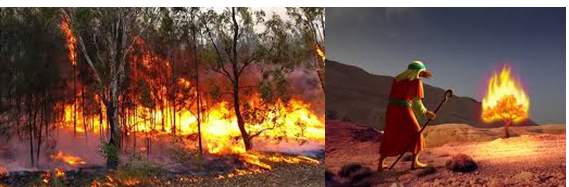
Today the prevalence of deadly wildfires is a sign of the devastating effects of climate change on the most vulnerable of our planet. Disintegration of ecosystems have led to habitat destruction and loss of livelihood for many of Earth’s species. Forests are being wiped out, animals are being driven out of their natural habitat, and forced migration of peoples all over the world are all happening at an alarming rate.
In this second week, we are again urged to listen to and really heed the different voices of creation. Moreover, we are being called to recognize our negligence and destructive patterns and to lament and ask pardon for our refusal to heed the anguished cries of Earth and her creatures. Laudato Si speaks very poignantly of our current situation:
The pace of consumption, waste and environmental change has stretched the planet’s capacity that our contemporary lifestyle, unsustainable as it is, can only precipitate catastrophes.
Week One: 1-7 September: Beginning the 2022 Season of Creation.
The theme for this year “Listen to the Voices of Creation” provides opportunities for deep reflection and sharing on the gift of creation, with its many different voices, both those that are loud and clear and those that are barely heard or not heard at all. Let this be an opportunity for us to take note of the many different voices that call us to listen, to really hear and heed what Earth and Earth’s people are asking of us in these times.
The symbol of the Burning Bush, the revelation of God’s Presence, is a reminder to us to “take off our sandals, contemplate our connection to holy ground, listen for the voice of creation and be filled with hope to quench the fires of injustice with the light of God’s healing love that sustains our common home.”
In his prayer intention for September, Pope Francis calls on all people of good will “to mobilize for the abolition of the death penalty throughout the world.”
We pray that the death penalty, which attacks the dignity of the human person, may be legally abolished in every country.


 The Covid-19 pandemic has created a global crisis for mental health. In addition to the isolation and anxiety which undermined the mental health of millions, there was a severe disruption of mental health services and a widening of the treatment gap for mental health conditions.
 Leadership Team and the members of St. Clare’s Advisory Council made plans to celebrate Mercy Day at the hospital.
 have caused to Indigenous families and communities and to honor those who have been affected by these injustices. The annual observance of this day was one of the Calls to Action from the Truth and Reconciliation Commission of Canada.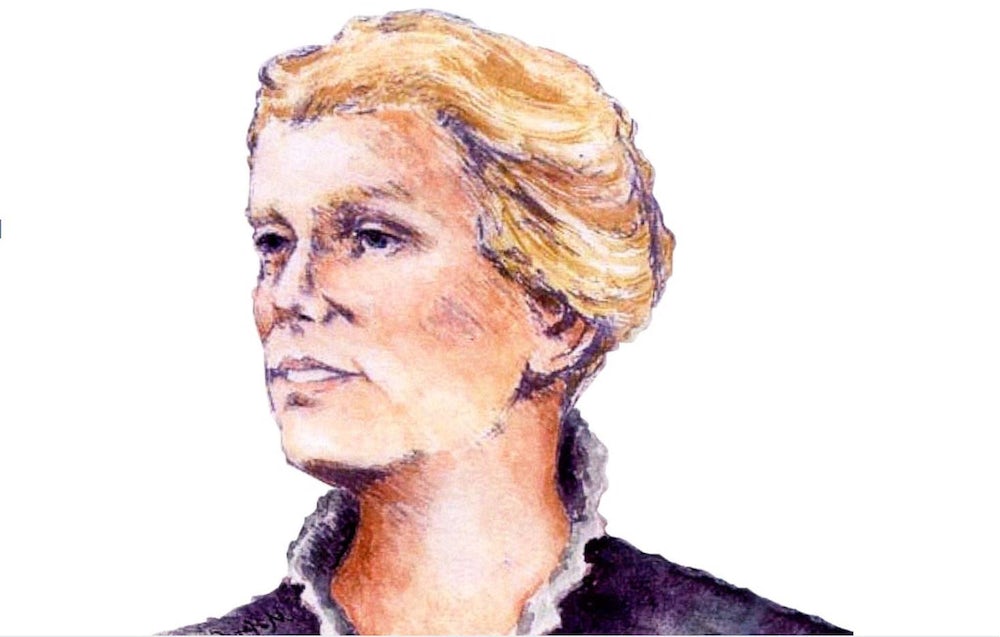
 This week of the Season of Creation calls us to amplify the many diverse voices that are crying out to us from our suffering Earth- home and from its most vulnerable creatures, both human and non-human. Most of us are aware of climate-change catastrophes, loss of biodiversity and other critical issues facing our planet, but awareness and lament are not enough. It is a well-known fact that those who have the least in our world and who have contributed least to the climate crisis suffer the most. Their voices cry out, but they are not easily heard at the national or global levels. Our call as Christians is to amplify these voices through advocacy.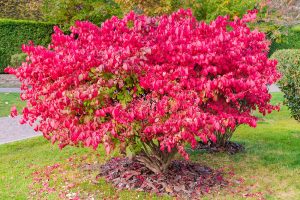
 The fire that attracted Moses’ attention on Mount Horeb while he was tending his flock did not consume or destroy the bush. God’s fire is not ultimately destructive. It is rather a sign of God’s Presence and life-giving and life-sustaining energy.This marvellous phenomenon that Moses experienced declared God’s presence in the midst of ordinary life. Elizabeth Barrett Browning captures this reality inher little poem:
 Today the prevalence of deadly wildfires is a sign of the devastating effects of climate change on the most vulnerable of our planet. Disintegration of ecosystems have led to habitat destruction and loss of livelihood for many of Earth’s species. Forests are being wiped out, animals are being driven out of their natural habitat, and forced migration of peoples all over the world are all happening at an alarming rate.