

Sister Mary Joseph Rawlins was born in St. John’s in 1846. As a child she attended Our Lady of Mercy School and also spent a short time at St. Clair’s Boarding School, which was attached to the school, and which functioned from 1861 to 1881. In 1863 at the age of seventeen she entered Mercy Convent as a postulant.
 During her eight years at Mercy Convent, Sister Mary Joseph studied music under the direction of Professor Thomas Mullock, brother of Bishop Mullock and the first organist at the Cathedral of St. John the Baptist. She was the aunt of Sister M. Aloysius Rawlins who played such a significant role in the early days of St. Clare’s Mercy Hospital.
In 1871 Sister Mary Joseph was transferred to St. Ann’s Convent in Burin where she taught music to children and adults from Burin and the surrounding area. Though she had studied music she had little experience in teaching it, but her time in Burin gave her plenty of opportunity to hone her skill. Sister Kathrine Bellamy in Weavers of the Tapestry, a history of the Mercy Sisters in Newfoundland and Labrador, states that “the parish choir was her biggest challenge and her greatest joy.” In 1879 as superior of St. Ann’s, Sister M. Joseph organized the construction of a new convent and a three-room school in a central location in Burin.
By 1917 Sister M. Joseph’s deteriorating health forced her to leave her beloved teaching ministry. Her good friend, Sister M. Bridget O’Connor who had been in Burin with her and who was now Superior General of the newly formed Congregation of the Sisters of Mercy of Newfoundland, urged her to return to St. John’s where she could get the best medical attention. However, Sister M. Joseph was reluctant to leave Burin, which had been her home for nearly fifty years and where she had many dear friends and cherished memories.
On August 17, 1918 when the Burin Sisters went to St. John’s for their annual retreat, Sister Margaret Mary St. John stayed behind to care for Sister M. Joseph. During Evening Prayer on August 19, Sister M. Joseph was stricken with severe paralysis. Later that night when her condition became more critical, Sister Margaret Mary rang the big convent bell to get assistance from the community. The women of Burin responded immediately, but Sister M. Joseph was beyond help and died the following day. She was the last sister to be buried in the Sisters’ plot in Burin.
- Read more Sisters stories documenting our Newfoundland Mercy Story
La hermana Mary Joseph Rawlins nació en St. John’s en 1846. De niña asistió a la escuela de Nuestra Señora de la Merced y también pasó un corto periodo de tiempo en el internado de St. Clair, anexo a la escuela, que funcionó de 1861 a 1881. En 1863, a la edad de diecisiete años, ingresó en el convento de la Misericordia como postulante.
Durante sus ocho años en el Convento de la Misericordia, la Hermana Mary Joseph estudió música bajo la dirección del Profesor Thomas Mullock, hermano del Obispo Mullock y primer organista de la Catedral de San Juan Bautista. Era tía de la Hermana M. Aloysius Rawlins, que desempeñó un papel tan importante en los primeros días del Hospital de la Misericordia de Santa Clara.
En 1871, la hermana Mary Joseph fue trasladada al convento de Santa Ana en Burin, donde enseñó música a niños y adultos de Burin y alrededores. Aunque había estudiado música, tenía poca experiencia en la enseñanza, pero su estancia en Burin le dio muchas oportunidades para perfeccionar su habilidad. La hermana Kathrine Bellamy en Weavers of the Tapestry, una historia de las Hermanas de la Misericordia en Terranova y Labrador, afirma que «el coro parroquial fue su mayor reto y su mayor alegría». En 1879, como superiora de Santa Ana, la hermana M. Joseph organizó la construcción de un nuevo convento y una escuela de tres aulas en un lugar céntrico de Burin.
En 1917, el deterioro de la salud de la Hermana M. Joseph la obligó a abandonar su querido ministerio de enseñanza. Su buena amiga, la Hermana M. Bridget O’Connor, que había estado en Burin con ella y que ahora era Superiora General de la recién formada Congregación de las Hermanas de la Misericordia de Terranova, la instó a regresar a St. Sin embargo, la Hermana M. Joseph se resistía a abandonar Burin, que había sido su hogar durante casi cincuenta años y donde tenía muchos amigos queridos y recuerdos entrañables.
El 17 de agosto de 1918, cuando las Hermanas de Burin fueron a St. John’s para su retiro anual, la Hermana Margaret Mary St. Durante la oración de la tarde del 19 de agosto, la Hermana M. Joseph sufrió una parálisis severa. Esa misma noche, cuando su estado se hizo más crítico, Sor Margaret Mary hizo sonar la gran campana del convento para pedir ayuda a la comunidad. Las mujeres de Burin respondieron de inmediato, pero la hermana M. Joseph no pudo recibir ayuda y murió al día siguiente. Fue la última hermana en ser enterrada en la parcela de las Hermanas en Burin.
- Lea más historias de Hermanas que documentan nuestra Historia de Misericordia de Terranova
 After the completion of her studies at St. Brides, Minnie entered the Sisters of Mercy, and at her reception into the novitiate received the name Sister Mary Benedicta. She was professed on December 27, 1887. During her years at St. Bride’s Sister M. Benedicta’s musical talent was developed under the direction of the highly skilled Sister M. Xaverius Dowsley, and she herself became an accomplished musician. She wrote the music for one of Archbishop Howley’s poems, Dear Old Southside Hills.
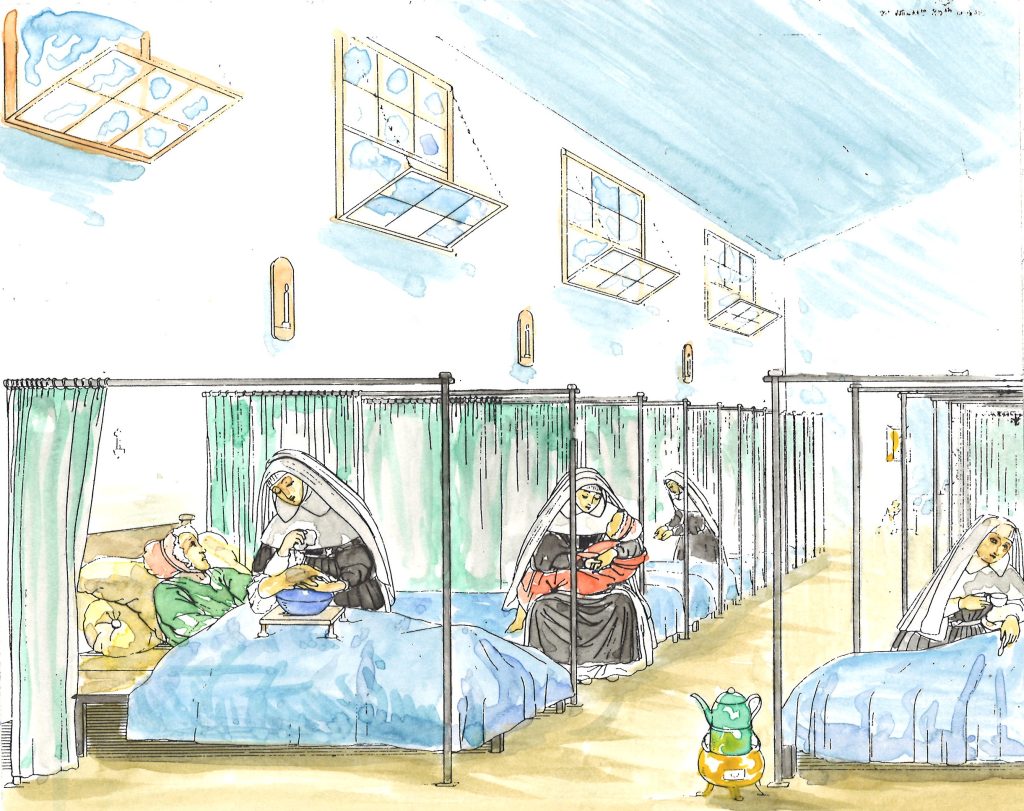 These two great women of Mercy faithfully carried out the works of Mercy as if there were dozens of sisters in the Newfoundland Mercy community – continuing in school and visiting the sick and poverty-stricken in their homes and in St. John’s Hospital (located near present-day Victoria Park). In June of 1947 when St. John’s was in the throes of a severe typhus epidemic, they closed school and devoted themselves entirely to visiting and caring for the sick. It was at St. John’s Hospital that Sister M. Joseph caught the dreaded fever from a young seaman who was suffering great physical and spiritual anguish. Despite the medical services of physicians and the loving care of Sister M. Francis, Sister M. Joseph died after two weeks of suffering the torments of the disease. She was 48 years of age and had only been a Sister of Mercy for four years.
 At her reception into the Novitiate on August 2 of that same year she received the name Sister Mary Patrick Ligouri. A local newspaper, The Newfoundlander, in its August 3,1865 issue, reported on her Reception Ceremony, noting that a couple of her brothers “our respected townsmen, the Messrs. Farrell” had emigrated to Newfoundland from Ireland and were well established in the business community of St. John’s by the time their sister arrived.
 Mary Ellen’s religious name was Sister Mary de Chantal, a name that became legendary over her nearly sixty years of Mercy ministry in Newfoundland. In September 1961, less than a year after her Profession of Vows, Sister M. de Chantal went to Brigus as a member of that founding community. In 1866 she became Superior of Mercy Convent in St. John’s, the second sister to hold that position since the death of Sister Francis Creedon. During her time of office, two new Mercy foundations were established – Conception Harbour and Petty Harbour. In 1861 she went to Burin as Superior of St. Anne’s Convent.
 She spent the early years of her religious life at St. Michael’s Convent, Belvedere and in 1904 was assigned to St. Bride’s Academy, teaching student teachers and senior students. Four years later she was transferred to Sacred Heart Convent in St. Lawrence, where she endeared herself to both students and parents. Upon her return to Belvedere in 1910 she took on the responsibilities of superior and novice mistress.