
The Sisters of Mercy of Newfoundland arrived in Peru in November 1961 when a group of six sisters took the long journey to participate in the mission of the Archdiocese of St. John’s in Monsefu, Chiclayo.
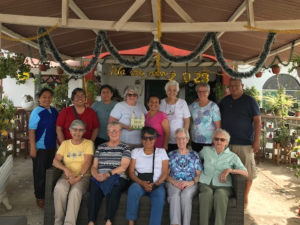 Our Sisters of Mercy now minister in two areas of the country – in Puerto Eten, Reque and Eten, in the Chiclayo region and in Huarmey, Ancash. Six sisters of the Congregation of the Sisters of Mercy of Newfoundland (including four native Peruvians) work with the people, especially those made poor, in towns and small villages in these two regions of Peru.
The sisters in Peru work closely with the people in catechetics, adult education, and in various aspects of parish and liturgical life. They serve as teachers, social workers, advocates and champions of social justice.
During the years of Covid 19 the Sisters were challenged to look for ways to respond to the numerous needs that arose at that 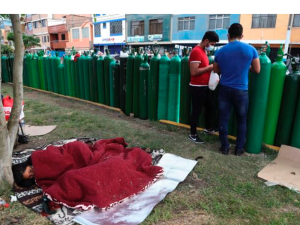 time. Peru was affected enormously by the onslaught of Covid and its health system collapsed totally. Together with our co-workers, the Conference of Religious of Lima, and The Conference of Religious of Chimbote, plans were made to look for and purchase an Oxygen Plant for the city of Chimbote.
In the Diocese of Chiclayo the Sisters had much support from Caritas organization, along with many individuals and NGOs, especially for their outdoor neighborhood kitchens . These kitchens are the main way people receive a hot meal each day.
An additional threat to the Peruvian people is the advent of Dengue Fever spread by mosquitos. This is undoubtedly due to the recent rains and floods. Climate change is certainly obvious.
It´s important to add that during these years as well much effort has been dedicated to help individuals and families to begin small jobs or businesses. Thus they become more independent and able to provide for their families. This includes raising small animals, beginning a store, providing a kiosk so that a person can sell food, selling products on the street, helping seamstresses by providing sewing machines, etc.
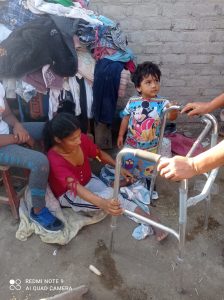 In the Diocese of Chiclayo the Sisters had much support from Caritas organization, along with many individuals and NGOs, especially for their outdoor neighborhood kitchens . These kitchens are the main way people receive a hot meal each day.
An additional threat to the Peruvian people is the advent of Dengue Fever spread by mosquitos. This is undoubtedly due to the recent rains and floods. Climate change is certainly obvious.
It´s important to add that during these years as well much effort has been dedicated to help individuals and families to begin small jobs or businesses. Thus they become more independent and able to provide for their families. This includes raising small animals, beginning a store, providing a kiosk so that a person can sell food, selling products on the street, helping seamstresses by providing sewing machines, etc.
The Sisters of Mercy and the Presentation Sisters in Newfoundland, along with some of the religious orders in Peru, provided 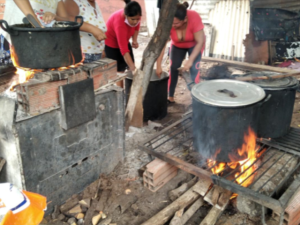 financial resources to obtain medical supplies and food for the people. Other aid came from the Peruvian government and other international agencies.
The Sisters were lead to recognize what they have lived through and are living through: the climatic disasters, the political instability, the insecurity, the corruption and terrific rise in violence. All of these factors affect them and their ministry. On the other hand they recognize the incredible resistance, resilience, courage and faith of the people shown and lived this past year. The gestures of solidarity at all levels has been quite visible.
Like all Sisters of Mercy, who live out the charism of Catherine McAuley, the Sisters in Peru continue reflections on questions, concerns and themes. They strive to “relieve misery, address its causes, and support all persons who struggle for full dignity” (Morning and Evening Prayer of the Sisters of Mercy, page 393)
Supporting the Ministry – Misericordia Mission Fund
Donations to the Misericordia Mission Fund, a registered charity established by the Sisters of Mercy of Newfoundland, are used in Peru to provide basic needs for poor families – food, clothing, fuel, medicine, education and shelter. Many children receive basic education and sometimes post secondary education through donations to the fund.
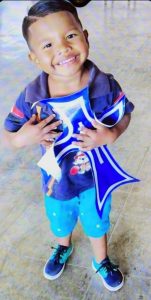 These last couple of years the Mission Fund has been able to respond to many needs caused by anti-government protests in the country when people could not work as usual; then the very heavy rains and floods have taken away not only peoples place of work, but many have lost homes and possessions. The fund has been used to form comedores and ollas communes (dining areas and common pots) and was able to lessen hunger and disease in many pueblos. Migrants, older people, and children are a special concern for our communities and the Mission fund works constantly with our lay people and coordinators to identify their needs and respond.
All donations to the Misericordia Mission Fund are used in their entirety for the needs of poor people. Donations received by the Misericordia Mission Fund in Newfoundland are distributed by the Sisters who are ministering in Peru. Income tax receipts are issued for all donations to the fund.
Misericordia Mission Fund
P.O. Box 1757
St. John’s, Newfoundland, Canada A1C 5P5
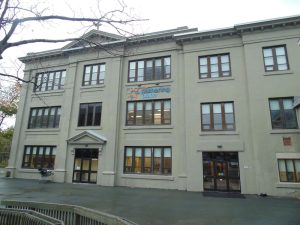
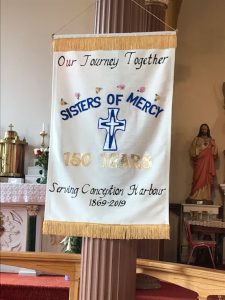 On Tuesday May 21 about thirty of us attended a grand celebration in the parish of Eucharist followed by a hot roast beef dinner. Sister Roisin Gannon represented the Presentation Sisters. Bishop Anthony Daniels surrounded by seven priests of the Grand Falls Diocese celebrated Eucharist in St. Anne’s Church with participation of the sisters and parishioners in readings, music and other moments in the liturgy. The church was sparkling and beautifully decorated with roses. A large banner hung in the church acknowledging the 150 years’ anniversary – Our Journey Together! At the end of Mass, a plaque was presented to the Congregation which will be placed in the church to commemorate the anniversary. In his homily Bishop Daniels connected the call and ministry of the sisters to that of the early disciples of Jesus and gratefully commended their life and ministry among the people of Conception Harbour and surrounding area.
 A new cosmological narrative with “Cosmos meaning all creation, the entire universe, every dimension of time and space (spiritual and material)” is one of “a global heartbeat” in “kinship as a planetary community”. In uniqueness, we are “aligned” /”in harmony”/ “in wonder”/”delight”/”bending low…play-ful” as “one with the heartbeat of God”.
 Pope Francis’ decision to expand participation in the Synod has made a significant impact on the Catholic world. Seventy non-bishop members are expected to participate in the synod being held at the Vatican in October, with half of the non-ordained beingwomen. The Pope also provided for greater gender parity among religious orders participating in the synod- five from women’s congregations and five from men’s.
 The Continental stage of the Synod is intended to be a time of reflection and discernment of all the local churches on a continental basis. These continental assemblies are meeting between January and March 2023 to prepare a response to the Synod’s working Document, Enlarging the Space of your Tent. This document is the result of a group reflection on the syntheses of issues and questions raised during the listening sessions of Stage One of the Synod, a stage in which we were all involved.
 La decisión del Papa Francisco de ampliar la participación en el Sínodo ha tenido un impacto significativo en el mundo católico. Se espera que setenta miembros no obispos participen en el Sínodo que se celebrará en el Vaticano en octubre, y que la mitad de los no ordenados sean mujeres. El Papa también dispuso una mayor paridad de género entre las órdenes religiosas participantes en el sínodo: cinco de congregaciones femeninas y cinco masculinas.
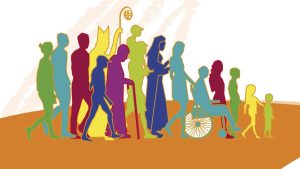 Identificación de las intuiciones contenidas en el documento que más resuenan con la experiencia de su territorio particular.