

Interesting Facts
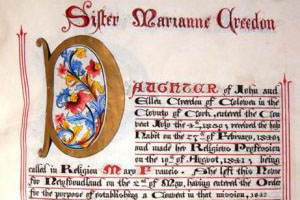
Sister M. Francis Creedon, as Miss Creedon, taught at Mrs. Little’s School for Young Ladies on Water Street in her early days in Newfoundland.
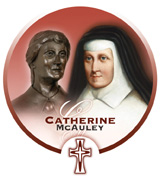
Sister M. Joseph Nugent had the unique distinction of being the first Presentation and the first Mercy postulant in Newfoundland. She and her family came to St.John’s in 1833 and shortly after, she entered the newly established Presentation Convent. Her health forced her to leave after two years of novitiate. Sometime in late 1842 she entered the Sisters of Mercy. Her profession ceremony in March of1843 took place at the Presentation Convent.
Sister Elizabeth Redmond was a widow. Born in Ireland, she married Irish-born Peter Redmond in the old chapel on Henry Street in St. John’s in 1843. After his untimely death, she entered the Sisters of Mercy in 1850, joining Sister M. Francis Creedon, Sister M. Agnes Nugent, a novice and Catherine Bernard, a postulant from Limerick.
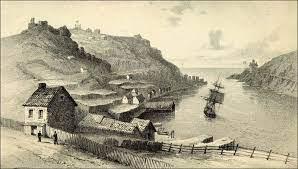
From the time of their arrival in St. John’s in June of 1842 until May of 1843 the Sisters of Mercy devoted themselves to the visitation and care of the sick in their homes and at St. John’s Hospital. This institution was Newfoundland’s main public hospital, founded in 1813, to serve the poor, sailors and the chronically ill. The sisters did not open their first school until May 1, 1843.
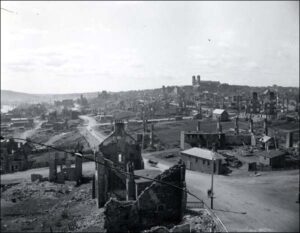
The Great Fire of 1846 wiped out most of St. John’s, destroying 2000 properties, among them the Presentation Convent and School on Long’s Hill. After temporary shelter at a property owned by Bishop Fleming, the sisters came to Mercy Convent in November of 1846 and remained there until October of 1851.
St. Michael’s Convent and Orphanage was named for Bishop Michael Anthony Fleming, dear friend and benefactor of the Sisters of Mercy. He had bequeathed the Sisters his property at Belvedere to support an orphanage for girls. St. Michael’s Convent and Orphanage formally opened on November 16, 1859.
In July of 1848 Bishop Thomas Mullock consecrated a section of the Belvedere estate as a Roman Catholic cemetery. This replaced the old Catholic cemetery on Long’s Hill.
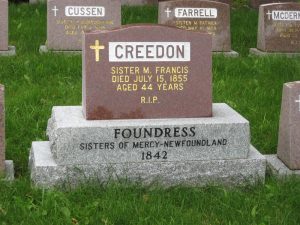
Sister M. Francis Creedon was the first Sister of Mercy to be buried in our section of Belvedere cemetery. She died on July 15, 1855.
The dowry of Sister M. Camillus Cole was used to erect headstones for her and Sister M. Francis Creedon at Belvedere cemetery. A native of Colliers, Conception Bay, Sister M. Camillus died just after her profession in 1860.
Angel Guardian School opened at Mercy Convent in September 1881 to accommodate the needs of children from age 3 to 8 years. On opening day 34 little girls and boys began school.
In 1864 the sisters at St. Michael’s Convent, Belvedere opened a new ministry on that site. The House of Mercy was a home where unemployed young women could be safely and comfortably housed and at the same time receive education and training for various employments.
In 1981 the city of St. John’s named one of its new streets Creedon Place. It is located in the southwest end of the city in the Cowan Heights neighborhood.
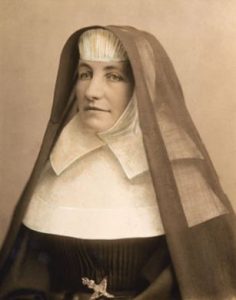
Sister M. Antonio Egan was born in England but emigrated with her family to Rhode Island. She entered the Sisters of Mercy in Providence and led the pioneer community at Sandy Point on Newfoundland’s west coast.
Sister M. Benedicta Fitzgibbons (1869-1959), an accomplished musician, wrote the music for Dear Old Southside Hills, a well- known poem of Archbishop Michael Francis Howley.

Sister Joseph Fox opened Newfoundland’s first commercial school at Mercy Convent in 1895? She began with five students and one typewriter.
The two-story Talbot wing of St. Bride’s, completed in 1902, was named for Thomas Talbot, an Irish-born gentleman prominent in the literary, educational and political life of Newfoundland. Half of the $20, 000.00 cost of construction the Talbot wing came from his estate.
“Talbot Bourses” were set up by the Sisters of Mercy in 1902 in consequence of the generosity of Thomas Talbot. In a formal document, the sisters pledged to provide a full year’s board and education at Littledale for two young women selected annually by the bishop of the diocese. This continued from 1902 until St. Bride’s closed in 1964.
In 1914 St. Michael’s Academy in St. George’s was recognized as a Teacher Training Academy to train teachers for Catholic schools in western Newfoundland?
Sister M. Perpetua O’Callaghan was awarded the degree of Doctor of Philosophy from Fordham University, New York in 1923? She was the first Sister of Mercy of Newfoundland to receive this distinction. She also received a diploma as Supervisor of Normal Schools from Columbia University.
Two Sisters of Mercy – Sisters M. de Chantal O’Keeffe and Sister M. Ignatius Guinane – left St. John’s to travel to the United States in 1892 to seek financial assistance for St. Michael’s Orphanage, Belvedere. Their appeal met a generous response in the dioceses of Brooklyn, Philadelphia and Boston where many former Newfoundlanders had settled.
Sister M. Corsini Dempsey, a gifted artist, embroidered a chasuble to be worn by Bishop O’Reilly in1953 at the Diamond Jubilee celebration of the Mercy foundation in St. George’s. It is now in the Archives of the Sisters of Mercy Generalate.
In 1937 Sister Philippa Hanley engaged the Sisters of Charity from Mt. St. Vincent in Halifax to conduct summer schools at Mercy Convent for both Mercy and Presentation Sisters.
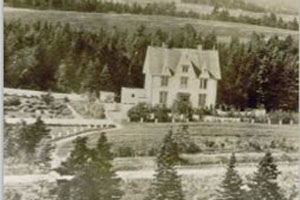
St. Bride’s Convent and Boarding school opened on August 20, 1884 with four sisters and four boarding students.
Prior to the opening of St. Brides’ Boarding School in 1884, Sisters M. Bernard Clune and M. Theresa O’Halleran went to Halifax to look at boarding schools and acquaint themselves with new educational practices and techniques.
The Sisters of Mercy from Belvedere did weekly visitation of the “Poor House,” situated in the area of Victoria Park. This government-run building, established in 1861 housed the elderly and destitute of St. John’s who had no-one to care for them. It was demolished in 1965, after which the residents were moved to the newly established Hoyles Home.
The December 1945 issue of The Monitor paid tribute to Sister M. Alexius Tobin in an article titled “A Social Worker for more than Sixty Years”. Although Sister M. Alexius ministered at the Orphanage and in the House of Mercy, her love for the less fortunate led her beyond Belvedere to the lanes and alleyways of St. John’s to visit the sick and the neglected.