

June 30, 2010
June 28, 2010 marked the launch of The Mustard Seed, the story of St. Clare’s Mercy Hospital written by Sister Kathrine Bellamy, rsm.  In her book Sister Kathrine set the story of St. Clare’s within the larger story of the Sisters of Mercy, the founding of the Congregation in Ireland in 1831, the foundation of the Newfoundland mission in 1842, the founding moment of the hospital in 1922 and the service and commitment of so many sisters and staff over the past 88 years.
In her book Sister Kathrine set the story of St. Clare’s within the larger story of the Sisters of Mercy, the founding of the Congregation in Ireland in 1831, the foundation of the Newfoundland mission in 1842, the founding moment of the hospital in 1922 and the service and commitment of so many sisters and staff over the past 88 years. Close to 150 people-Sisters of Mercy, the Bellamy family, friends, employees, volunteers and retirees-assembled to celebrate the event. Gary Cranford, publisher of Flanker Press, brought greetings to those gathered and spoke of how pleased he was to publish a second book by Sister Kathrine, referring to her previous book, Weavers of the Tapestry (2007).
Sister Elizabeth Davis, Congregational Leader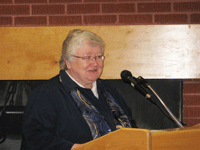 of the Sisters of Mercy, brought greetings on behalf of the Sisters, noting that it was an evening to celebrate an author, a book, a ministry and a place of healing. In her remarks, Sister Elizabeth paid tribute to Sister Kathrine as a woman of Mercy, noting that her legacy to our province and to our Church is a rich and deep one, citing especially her giftedness as a musician, her leadership within the community at large and within our Congregation. as a social activist, and as a historian. Referring to The Mustard Seed, Sister Elizabeth noted that it is a rich history of St. Clare’s and our city’s health care system. She described it is a significant accounting of a ministry which we have held precious from the first years of our coming to Newfoundland to this day – the healing ministry. Sister Elizabeth concluded by saying that we celebrate a place of healing, St. Clare’s Mercy Hospital, and the women and men who have carried out their work over the past eighty-eight years, the many professions and disciplines and support positions which have been and remain the heart and spirit of this place of healing.
of the Sisters of Mercy, brought greetings on behalf of the Sisters, noting that it was an evening to celebrate an author, a book, a ministry and a place of healing. In her remarks, Sister Elizabeth paid tribute to Sister Kathrine as a woman of Mercy, noting that her legacy to our province and to our Church is a rich and deep one, citing especially her giftedness as a musician, her leadership within the community at large and within our Congregation. as a social activist, and as a historian. Referring to The Mustard Seed, Sister Elizabeth noted that it is a rich history of St. Clare’s and our city’s health care system. She described it is a significant accounting of a ministry which we have held precious from the first years of our coming to Newfoundland to this day – the healing ministry. Sister Elizabeth concluded by saying that we celebrate a place of healing, St. Clare’s Mercy Hospital, and the women and men who have carried out their work over the past eighty-eight years, the many professions and disciplines and support positions which have been and remain the heart and spirit of this place of healing.A number of Sister Kathrine’s family members were present including her nephew, Reverend William Bellamy. Fifteen members of Mercy School Choir alumnae, accompanied by Brenda (Molloy) Mooney and directed by Marilyn (Burke) Murphy added their voices to the celebration. The musical pieces were chosen to be part of the event in tribute to Sister Kathrine who taught these pieces to her choir and who passed on to them a great love of music and song.  One of the pieces that they sang, Salve Regina, was composed by Sister Kathrine. They were thrilled to have been invited to honor Sister Kathrine and the publication of her book.
One of the pieces that they sang, Salve Regina, was composed by Sister Kathrine. They were thrilled to have been invited to honor Sister Kathrine and the publication of her book.A collage of photos from the launch of Sister Kathrine’s Weavers of the Tapestry had been prepared by Marilyn (Mulrooney) Cameron and her daughter, Laura and was displayed during the launch.
Following the official launch, a reception for the guests was provided by Flanker Press. It provided an opportunity for friends and acquaintances to converse with each other, to share memories, to tell stories, and to purchase copies of The Mustard Seed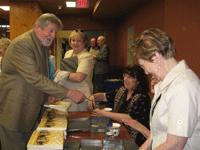
On a sad note:
Sister Kathrine died before the publication of her book, but it was fortunate that she had already passed her manuscript to the publishing company. She had already chosen its title, taking it from the address of Archbishop Roche during the Opening of St. Clare’s Liturgy on May 21, 1922. He stated that the Sisters of Mercy are “planting a tiny grain of mustard seed, which we hope will grow into an immense tree, throwing its healing branches over different sections of the country.”